


L-R: W. Bro Darryl Bubb, W. Bro Stan Marut (CHAPS AMBASSADOR) and W. Bro Mike Emmett. (The TDMC Team)
This report from W. Bro Stan Marut PPrJGD SLGR – CHAPS Ambassador.
CHAPS was delighted to have performed Prostate Cancer (PCa) screening again for the Masonic Province Prostate Cancer Screening at events held at Harrow and Twickenham in July 2026. At the events a total of 170 men of whom 164 met screening criteria were tested and the event statistics are shown below. This is the full report from CHAPS and highlights the invaluable service provided to the Province.
With an estimated 63,000 new cases every year, PCa is the commonest major cancer in the UK and the only one still with no national screening programme despite clear evidence of a clinical, social, and economic benefit from screening, which could reduce our death rate from 13,000 to 7,000 a year. Many requests for PSA tests are declined by GPs still advising not to test “till symptoms arise” – too late for a cure.
Since 2014 the CHAPS PSA-based programme has been demonstrating that PCa screening can be run at scale with substantial benefit and statistical validity. The Programme’s risk-based, PSA protocol matches the best in Europe and the USA and has been adopted by most of the testing Charities in England and Wales screening about 100,000 men in 2025. This protocol provides each man who has a normal result with his actual PSA level in ng/ml, his individual risk assessment and, based on his risk, a recommendation on how often to repeat the PSA test. For men with an abnormal PSA, a recommendation is made to see the recipient’s GP for further assessment. All attendees were given an information leaflet outlining this in detail and emphasising that PSA is only a guide and not in itself diagnostic of PCa. Menwith a persistently raised PSA require referral by their GP to a specialist Urologist. The definitive diagnostic investigation is an MRI scan of the prostate plus, if necessary, a biopsy of the prostate gland under local anaesthetic.
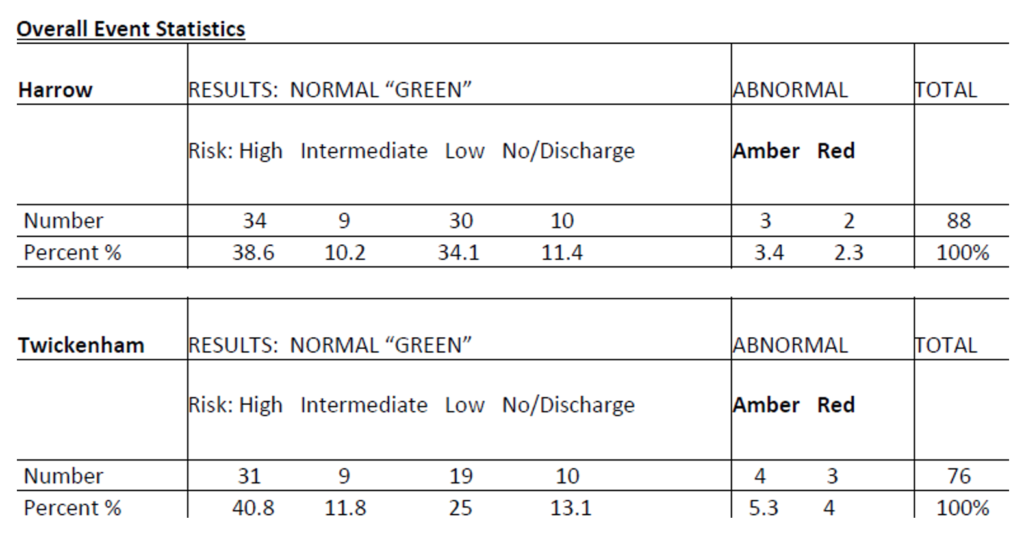
In overall percentage terms these results are broadly in line with anticipated statistics particularly as a high proportion of the attendees were for follow-up tests as opposed to first time screening.
There were 12 (7.3%) abnormal results, it is estimated that of these, 3 will have PCa. Detection of PCa and abnormal PSA results at any event are only part of the event’s objective. One in 8 UK men will develop PCa in their lifetime. Many will develop in the 65 (39.6%) men with a normal result but identified as High Risk because of a family history of PCa, breast or ovarian cancer, black African or Caribbean ethnicity, or a PSA in the upper quarter of the normal range. Eighteen (11%) men were at Intermediate Risk, due to either, a possible family history but mainly due to having a PSA in the 50-74th percentile of the normal range.
If these men continue regular screening into their 70s, across the danger years, initially annually for High-Risk men and repeated PSA tests 2-yearly for Intermediate Risk men, we can expect to identify
many more cancers at an early, curable stage. We will issue reminders to each man when follow-up PSA tests are due. In simple terms, these events should identify developing cancers at a curable stage. Most men – 49 (29.9%) – are at Low Risk and only need tests at 3 yearly intervals. We stress this to prevent “over-testing” which is commonplace. Over-testing is wasteful, medically unsound and leads to “over-diagnosis” and “over-treatment” of harmless, “insignificant” PCa. This is a “harm” of screening, and a key argument justifying opposition to a national programme. Programmed testing reduces this risk. Twenty (12.2%) elderly men with low PSAs were reassured that they will not develop a life shortening PCa and need no further PSA tests.
This organised programme aims to halve the PCa death rate for participants, far more than achievable by one-off and random tests. Our reminder and recall service will improve screening performance by increasing screening for men at high risk and reducing it for men at low risk. A comprehensive report specifically on screening compliance in the Province from 2022 to 2026 will follow shortly but our aggregate outcome statistics for the CHAPS PCa Screening Programme are as follows:

We will audit the abnormal results from this event later in 2026 and all high-risk men will be issued with a reminder when their retests are due in 2027. The equivalent figures for the Province in 2025 were 2 abnormal results and 2 cancers detected, both receiving radical treatment.
Conclusion
The statistics confirm that we are detecting life-threatening cancers at a highly significant rate and curable stage. We are demonstrating that screening can be done at scale and, indeed, in several NHS pilot studies the beneficial results mirror our own. We are introducing the concept of organised screening to the voluntary sector to identify men at risk for whom screening should be intensified whilst reducing over- screening for most men who are at low risk.
This Life saving testing programme was generously supported by the PROVINCE OF MIDDLESEX BENEVOLENT FUND for which a big thank you is necessary.
A grateful thanks also to the Harrow Team and the Management at both Harrow and Twickenham for supporting the testing initiative and making facilities available.


