

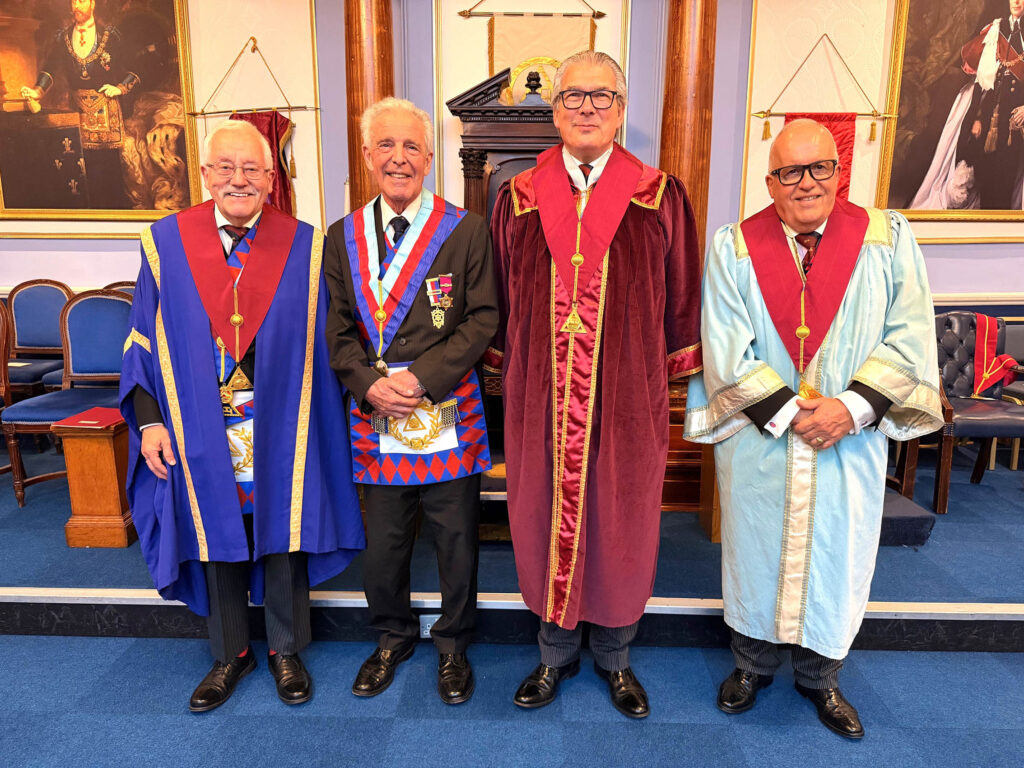
L to R: E. Comp Martin Kemble PAGSoj (H), E. Comp Jeffery Monnickendam PGSoj, E. Comp Nigel Codron PGStB (MEZ), E. Comp David Wareham PPrGSN (J)
The March Convocation of Middlesex 1st Principals Chapter No 3420 took place on Monday 23rd March at Twickenham, where the Gordon Bourne Annual Lecture was presented. After the regular business of the Chapter, the First Principal introduced E. Comp Jeffrey Monnickendam, PGSoj who gave a talk entitled “The Connection of the Whole System”.
These words form part of the exhortation in the 3rd degree where we are to distinguish and appreciate the connection of our whole system, and the relative dependence of its several parts. In this instance, we are guided to consider the links between the Craft and the Royal Arch. E. Comp Monnickendam gave a highly erudite presentation of some of the aspects of the Royal Arch and its resonance with the Craft.
The object was to indicate what he thought were the links in the Craft to the Royal Arch. He illustrated this in part by alluding to the usage of the word ‘Companion’ in the 3rd Degree. When the candidate is raised by the Worshipful Master who says, “It is thus all Master Masons are raised from a figurative death to a reunion with the Companions of their former toil.” (Taylors Ritual). He then went on to suggest that in the ritual where the Principal Sojourner “accidentally strikes the rock with his crow and remarks a hollow sound” alludes to one’s head, and the tools were to assist in loosening our stubborn concepts and the clearing away enabled us to better appreciate what the Royal Arch has to offer.
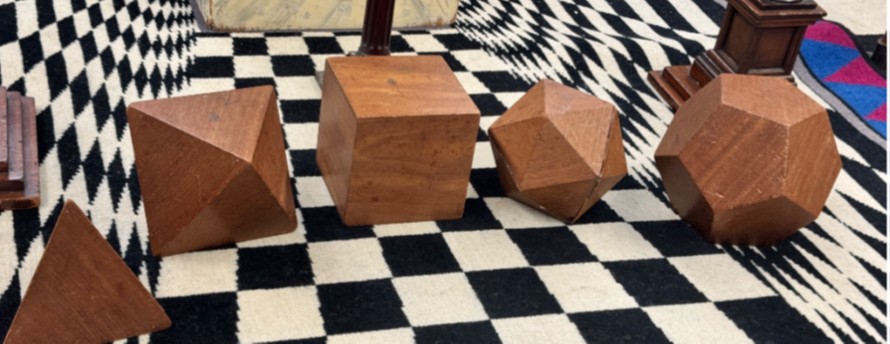
Image taken from The Square magazine.
The Platonic Bodies
He mentioned the Platonic Bodies which are displayed in a Royal Arch Chapter and follow the philosophy of the Greek Philosopher Plato. (Ed’s note –Platonic solids have long been imbued with symbolic and mystical significance and In Western esoteric traditions – notably in Freemasonry – they are regarded as sacred geometric forms that encode deep philosophical and cosmological truths.
Freemasonry, with its historical roots in stonemasons’ guilds and an emphasis on geometry and architecture, adopted Platonic solids into its symbolism by at least the early 19th century – Platonic Solids by Maarten Moss – The Square Magazine – https://www.thesquaremagazine.com/mag/article/2025q2platonic-solids/)
The circular perambulations in the Chapter, he said, may be considered as suggesting the circularity of connections between the Craft and the Royal Arch. Additionally, he briefly alluded to the Point Within a Circle and its meaning for us as Freemasons.
A Companion asked a question as to why wasn’t a Chapter tiled? There would need to be an understanding of how the Royal Arch was in the 18th Century. There were freemasons called Arch Masons who represented a specific class of mason who had served as the Master of a Craft Lodge and that unlike the modern “stand-alone” Chapter, 18th-century Arch Masonry was intimately woven into the life of the Craft Lodge itself. Ask Copilot and its amazing how much it will tell you. However, the speaker did mention that as Arch Masons were an integral part of the Lodge, the Lodge would be called off and the Arch Masons would do their “thing” and then the regular Lodge would be called on afterwards. Therefore, a Chapter was not tyled.
Certainly, the talk provided much food for thought and although we are not all versed in the esoteric aspects of freemasonry, this is an important aspect of our overall understanding and was greatly appreciated by all the Companions present.
Edited by E. Comp Stan Marut PPrGReg, PPrGReg (Hants IoW) SLGCR
Provincial Media Team


